AI & Cybersecurity
Beyond the Essential Eight: How Australian Businesses Should Prepare for ASD's New Cybersecurity Framework
September 25, 2026
AI & Cybersecurity

Think about what it actually takes to exploit a publicly accessible web application today. According to IBM's 2026 X-Force Threat Intelligence Index, attacks that begin with exploiting public-facing applications rose 44% in a single year, driven in large part by AI tools that help attackers find weaknesses before human IT teams can patch them. Moreover, IBM observed that vulnerability exploitation, not the usual phishing or credential theft, was the leading cause of incidents in 2025.
The uncomfortable reality for most organisations is that their security testing hasn't kept pace with either their release cycles or their attackers. Code ships weekly. Features are added continuously. APIs multiply. And somewhere in that pipeline, a vulnerability is introduced, goes undetected through the next quarterly scan, and remains exposed until an adversary finds and exploits it.
Traditional, periodic penetration testing was not designed for this type of environment.
The traditional penetration testing model works roughly like this:
If your organisation runs two or three software deployments a week, that model won’t suffice. It has been structurally broken for some time.
Gartner's recognition of Adversarial Exposure Validation (AEV) as a distinct market category in its 2026 Market Guide reflects this problem. It defines AEV as technologies that deliver consistent, continuous, and automated evidence of the feasibility of an attack, confirming how potential attack techniques would actually exploit an organisation rather than simply theorising about them.
The emergence of this category is a signal that the industry has accepted something many appsec practitioners have known for years: point-in-time testing leaves exposures that adversaries are ready to exploit.
On the application side, Gartner's Application Security Testing market listings show a similar shift, with continuous SaaS-based DAST (Dynamic Application Security Testing) solutions gaining traction precisely because they replace periodic assessments with ongoing visibility.
Read More: Common Vulnerabilities Identified by DAST - Application Vulnerability Scanning
The question worth asking is: where does your organisation sit between periodic and continuous testing?
Dynamic Application Security Testing (DAST) and Static Application Security Testing (SAST) are the two established pillars of a mature application security programme. They're complementary by design, and the easiest way to see why is to put them side by side:
DAST reflects what an attacker actually sees because it operates without source code access, probing your application the way an external adversary would. The kind of issues a continuous DAST programme picks up include:
SAST works the other way around. It analyses source code, infrastructure-as-code, and build files before deployment, catching vulnerabilities at the point where they're cheapest to fix. Hardcoded secrets, insecure coding patterns, and dependency risks are all visible to SAST before a single line of code hits production.
Used together continuously rather than periodically, DAST and SAST close the window between when a vulnerability is introduced and when it's discovered. That window is where security breaches happen.
While DAST and SAST complement each other well, there’s a problem that DAST and SAST alone can’t fully solve. Even after a vulnerability is found, reported, and remediated by a developer, someone has to verify that the fix actually worked. A vulnerability finding marked resolved can still remain exploitable if the fix was incomplete or ineffective.
In the traditional model, verifying that a fix actually worked means logging a retest with your security provider, waiting for a consultant to become available, and sitting on a potentially ineffective fix in the meantime.
The Google Cloud Cybersecurity Forecast 2026 makes a pointed observation about where AI is heading in security operations: analysts are moving away from manual data correlation and toward directing AI agents that handle the repetitive verification work. Jon Ramsey, VP & GM of Google Cloud Security, frames it plainly: “Organisations need to be prepared for threats and adversaries leveraging artificial intelligence.”
The same principle applies to the defensive side of application security. If AI is compressing the time between an attacker identifying a weakness and exploiting it, then the time between a defender remediating a finding and confirming the fix needs to compress as well. Manual retesting, with its queuing delays and consultant availability constraints, is poorly suited to that pace.
This is the revalidation window: the period between a developer marking something as fixed and someone confirming it actually is. If that window is left open, it leaves organisations operating on assumed security, where unresolved or ineffective fixes remain exploitable in production.
Closing it requires continuous validation capability built into the testing workflow itself, not bolted on as a separate engagement.
Read More: Introducing Blacklock's On-Demand Vulnerability Scanning Service, Redefining Your Cybersecurity Approach
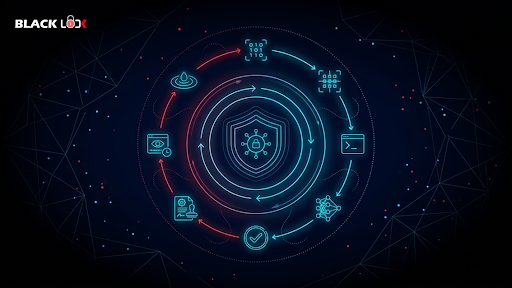
Continuous application security isn't a single tool. It's a connected workflow where the pieces reinforce each other:
Blacklock’s PTaaS platform is built around this model. Continuous DAST scanning covers web applications, REST APIs, and external infrastructure on a scheduled, recurring, or on-demand basis. SAST and DevSecOps integrations connect with GitHub, GitLab, Azure DevOps, Zapier, Jira, Slack, and Microsoft Teams, enabling scans and results to be embedded into existing development workflows and aligned to release cadence.
The platform’s Automated Security Validation capability helps close the revalidation gap. When a developer remediates a vulnerability and runs an on-demand retest, Blacklock’s Agentic AI initiates a revalidation cycle, selects the appropriate testing technique, retests the target, analyses the output, and provides an open-or-closed verdict for user approval. This reduces reliance on manual retesting and helps teams verify fixes faster.
With 150+ customers and a 95% renewal rate, Blacklock’s model shows that continuous security testing is operationally achievable for organisations that may not have large enterprise security teams.
Your development team is already shipping continuously. Your attackers are already operating continuously. The only question is whether your security testing is keeping up with both of them.
If you’re still relying on annual pen tests, you’re making decisions on a snapshot that’s already stale.
Join our newsletter today and enhance your knowledge with valuable insights. It's quick, easy, and free!