General
Attack Surface Sprawl: Why Most SMBs Don't Actually Know What They're Exposing to the Internet
October 7, 2026
General
Most SaaS companies know they need a more mature secure development lifecycle. Fewer know how to get there without hiring a dedicated AppSec team or grinding through months of process change.
OWASP SAMM (Software Assurance Maturity Model) provides the roadmap, encompassing five business functions, fifteen security practices, and three maturity levels each. But SAMM is deliberately tool-agnostic. It defines what mature looks like, not how to get there. If your SaaS teams are shipping weekly, the right platform can compress years of improvement into months. Here's how automated security testing paired with AI-driven validation maps to the SAMM practices that matter most.
Of SAMM's fifteen practices, three offer SaaS companies with active development teams the highest return on tooling investment.
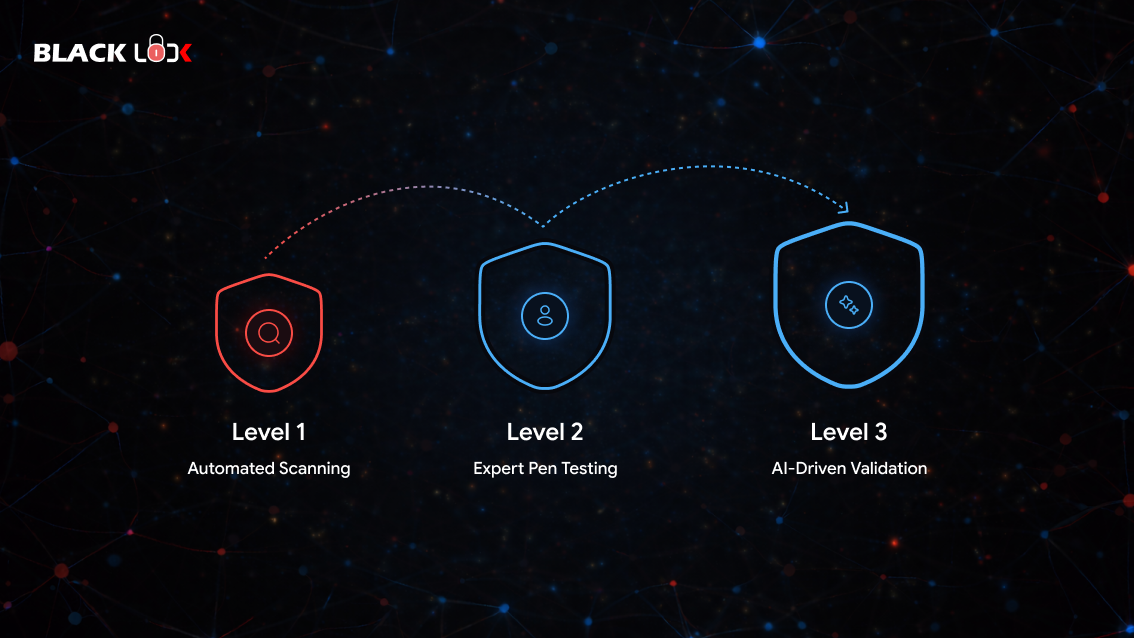
Security Testing (Verification) is split into two streams: Scalable Baseline, covering automated SAST and DAST, and Deep Understanding, covering expert manual penetration testing. Level 1 asks whether you scan with automated tools at all. Level 3 asks whether those tools are integrated into your build process, with results feeding a centralised dashboard.
Secure Build — Software Dependencies (Implementation) addresses supply chain risk. Level 1 requires a current Bill of Materials for every application. Level 2 demands systematic evaluation of dependencies and timely reaction to emerging risks.
Defect Management (Implementation) determines whether vulnerabilities actually get fixed and how fast. Level 1 calls for structured defect tracking. Level 2 demands consistent severity ratings, defined SLAs, and metrics that drive prioritisation.
Most SaaS teams sit somewhere between Level 1 and Level 2. Meaning testing happens, but it's ad-hoc, disconnected from CI/CD, and hard to report on.
Read More: Configuring ModSecurity with OWASP CRS – Part II
Here's where specific tooling choices matter. Blacklock's PTaaS platform was designed around the same problems SAMM identifies, and its capabilities map to the maturity progression the model defines.
At Level 1, SAMM asks you to run automated SAST and DAST tools with increasing frequency. Blacklock delivers continuous DAST scanning of web applications and APIs alongside SAST across 30+ languages, triggered on deployment through integrations with GitHub, GitLab, BitBucket, and Azure DevOps.
Level 2 pushes for customisation. That typically amounts to tuning tools to your stack and minimising false positives. Blacklock's proprietary interpretation engine handles this by ingesting output from multiple scanning tools, normalising data, removing duplication, and producing structured vulnerability records with contextual remediation guidance.
Level 3 requires automated tests integrated into build and deploy, with results merged into a central dashboard. Blacklock's unified dashboard consolidates scan results, SBOM reports, pen test findings, and certificates in one place, with Jira, Slack, Zapier, Vanta and Microsoft Teams integrations routing findings into existing workflows.
Level 1 calls for manual testing of high-risk components, e.g., authentication, access control, and session management. Blacklock's CREST-certified testers (holding OSCP, OSWE, OSCE, and CISSP credentials) deliver on-demand manual testing covering business logic and access control flaws that automated tools miss.
Level 2 asks for penetration testing at regular intervals with stakeholder-reviewed results. Blacklock's platform provides scheduled, repeatable pen testing with three tailored reports per engagement: Executive, Developer, and Full Penetration Test. So, the right information reaches the right audience.
The bridge toward Level 3 is where AI changes the equation. SAMM's highest maturity level demands that testing results continuously feed back into development. Blacklock's agentic AI vulnerability validation engine removes one of the biggest bottlenecks on the path to Level 3: remediation verification.
When a fix is deployed, the Agentic AI validation engine analyses the original finding, selects validation techniques, executes testing, and delivers an evidence-based verdict in real-time. This closes the gap between remediation and confirmed assurance, which typically stalls the feedback loop that SAMM Level 3 requires.
Read More: OWASP Top 10 LLM Risks and Their Impact on Businesses
SAMM Level 1 requires a Bill of Materials for every application and the ability to trace CVEs to affected apps. Blacklock's SBOM scanning generates this automatically from code repositories, cataloguing each dependency with version info, licensing details, CVE IDs, and CVSS scores, with exports available in SPDX and CycloneDX formats.
Level 2 demands timely reaction to dependency risks. Unlimited one-click rescanning and GitHub integration keep your SBOM current as your codebase evolves rather than a snapshot that's stale by the next sprint.
SAMM Level 1 wants structured defect tracking and informed decision-making. Blacklock's dashboard delivers prioritised vulnerability records with direct Jira, Zapier and Vanta integration for ticketing, automating workflows and Slack or Microsoft Teams for notification.
Level 2 calls for consistent severity classification and metrics. The three-report format (Executive, Developer, Full) provides this layering: leadership gets risk posture, developers get remediation code, and audit teams get the full record.
The barrier to SAMM maturity isn't the lack of knowledge. Most security teams understand what Level 3 looks like. The barrier is the lack of execution. SAMM's highest Security Testing level explicitly requires automated tests in the build process, correlation of multi-scanner results into a central dashboard, and a feedback loop where test results improve development itself.
Each requirement used to demand dedicated security engineering headcount and months of integration work. Blacklock's agentic AI validation engine and interpretation engine compress that into platform-managed workflows. Remediation verification that once required scheduling a consultant happens autonomously, on demand, within the same dashboard where findings were reported.
For SaaS companies, this is the difference between a security program that keeps pace with release velocity and one that's perpetually a quarter behind.
Run a SAMM self-assessment across Security Testing, Secure Build, and Defect Management. Most SaaS companies find they're at Level 1 in at least two of the three. Then pick the practice with the widest gap.
Blacklock is built for incremental adoption: start with vulnerability scanning, add SAST and SBOM scanning as your pipeline matures, and layer in manual penetration testing when you need deeper assurance. A 14-day free trial gives you full platform access, which is enough to run your first scans and see where your SAMM maturity actually stands.
Join our newsletter today and enhance your knowledge with valuable insights. It's quick, easy, and free!