Cybersecurity | Vulnerability Research
PHP2Shell: Critical PHP Vulnerabilities Expose Web Servers to Remote Code Execution
October 23, 2026
Cybersecurity | Vulnerability Research
Penetration Testing as a Service (PTaaS) and continuous vulnerability scanning have become standard components of modern security programmes. As organisations adopt agile delivery, CI/CD pipelines, and cloud-native architectures, security testing needs to operate at the same pace, i.e., on-demand, repeatable, and scalable.
Automated Dynamic Application Security Testing (DAST) and vulnerability scanners make this possible. They allow teams to test frequently and across large attack surfaces without waiting for scheduled engagements. However, this scale comes with a cost: noise. Automated scans routinely generate false positives, duplicate findings, and issues that are no longer relevant by the time developers review them.
The downstream impact is familiar to most AppSec and development teams. Developers lose time chasing issues that aren’t real. Remediation cycles slow down. Over time, confidence in security tooling erodes, and genuine risk can be missed among the clutter.
One way to eliminate false positives is through vulnerability validation, which verifies whether an issue persists after a fix has been deployed. But traditional validation relies on human retesting, which doesn’t scale in a PTaaS model designed for speed and volume.
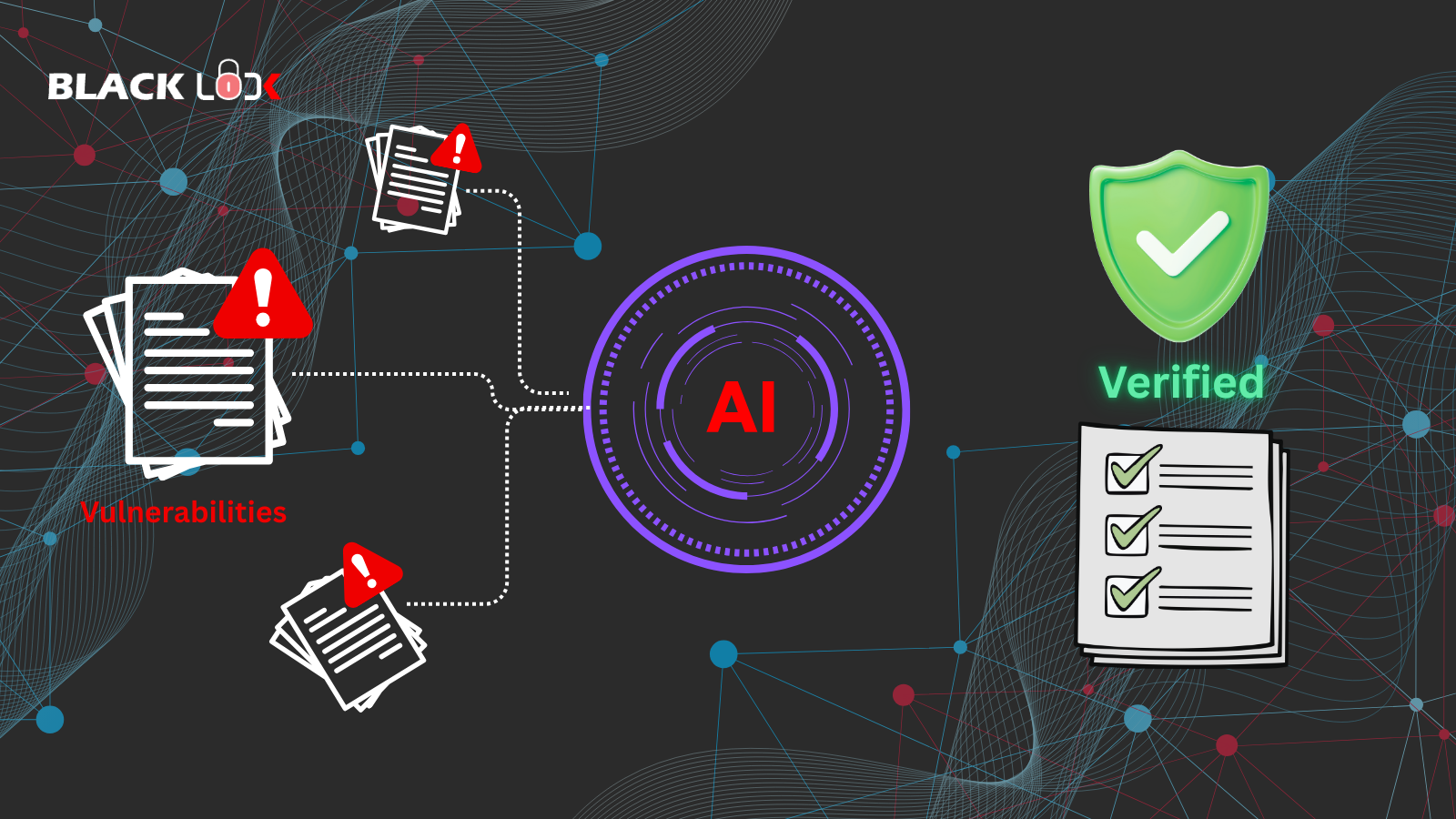
This is where AI-driven vulnerability validation, as implemented by Blacklock, improves the model.
In traditional penetration testing workflows, vulnerability validation is a manual, consultant-led activity. Once a vulnerability is reported, developers apply a fix and request a retest. A human penetration tester must then return to the application and determine whether the issue has been resolved. If resolved, the vulnerability is marked as Closed and consultant update the report manually.
In a modern PTaaS environment, this model quickly becomes a constraint.
Manual revalidation introduces several structural limitations:
There is also a less visible but significant risk. In organisations running continuous scanning and frequent releases, this approach won’t suffice. A PTaaS platform built for speed and scale can’t rely on human availability to close the loop on every fix. To make revalidation viable at scale, the process itself must be automated.
Read More: Automated Security Validation With Agentic AI
To overcome the scaling limits of manual retesting, Blacklock applies Agentic AI to vulnerability validation as a dedicated, automated workflow that activates after remediation.
The process typically begins when a developer marks a reported vulnerability as ready for retest. This action triggers a revalidation cycle rather than a new discovery scan. The intent is precise: confirm whether the specific issue that was previously identified still exists in the current environment.
Blacklock’s Agentic AI framework then analyses the original vulnerability record in detail. This includes the vulnerability description, its impact, and the supporting evidence captured during initial testing. Using this context, the AI determines the most appropriate validation technique for that specific issue. It reproduces the validation steps needed to confirm whether the remediation was effective.
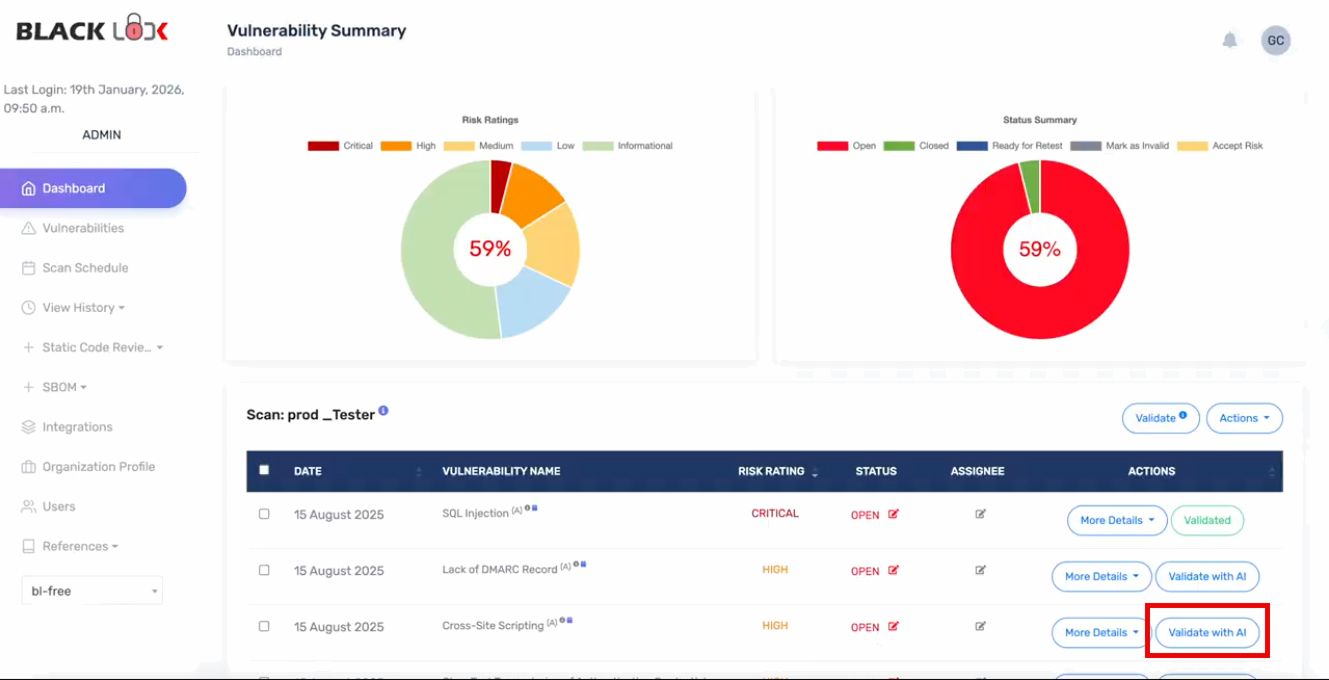
Once the approach is selected, Agentic AI executes the vulnerability validation workflow end to end. Tool selection, test execution, and result analysis are handled autonomously, without requiring a human penetration tester to manually re-run checks. This allows revalidation to commence immediately after fixes are deployed, rather than waiting for retest availability.
The outcome of each revalidation cycle is explicit and evidence-backed. The system produces a clear verdict indicating whether the vulnerability is fixed or still present, along with execution logs and supporting artefacts that show how that conclusion was reached. These results are recorded against the original finding, preserving a full audit trail.
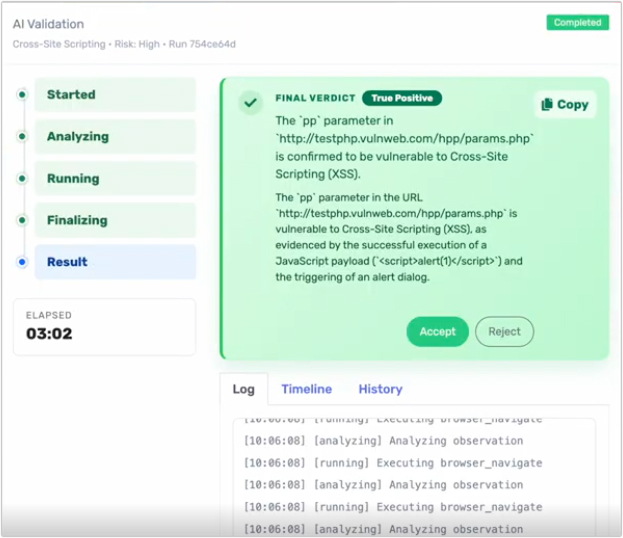
Importantly, human oversight is retained. Developers or security teams can review the evidence and accept or reject the AI’s verdict. This human-in-the-loop control ensures accountability and governance while removing the operational burden of manual retesting.
Read More: A Roadmap for Business Leaders: Enhancing Cybersecurity Maturity with PTaaS
False positives typically enter the PTaaS pipeline at the point of automated scanning. Tools such as DAST are designed to identify a wide range of runtime issues, from misconfigurations to injection flaws, XSS, and sensitive data exposure. But in doing so, they can flag conditions that aren’t actually exploitable or relevant to the current state of the application.
Rather than treating this as a separate scanning problem, Blacklock addresses it by applying Agentic AI immediately after automated scans. In this model, scan results are passed to Agentic AI for revalidation.
Agentic AI reproduces the validation steps associated with each finding, using the original scan output as its input. It then determines whether the condition reported by the scanner can still be observed in the live environment. If the issue cannot be reproduced, it is conclusively identified as a false positive and closed with supporting evidence. If it persists, it remains open as a verified, actionable issue.
This approach removes ambiguity from vulnerability management. False positives are eliminated based on proof instead of mere assumptions. At the same time, true positives are confirmed with execution evidence rather than pure trust in a scanner’s output.
As a result, developers regain confidence that the issues they are asked to fix are real. Similarly, security teams spend less time triaging noise, and remediation cycles become faster and cleaner.
Start a free trial of Blacklock today and experience firsthand how agentic AI can eliminate false positives and make evidence-backed validation part of your everyday PTaaS workflow.
Join our newsletter today and enhance your knowledge with valuable insights. It's quick, easy, and free!